Overview of Lesson:
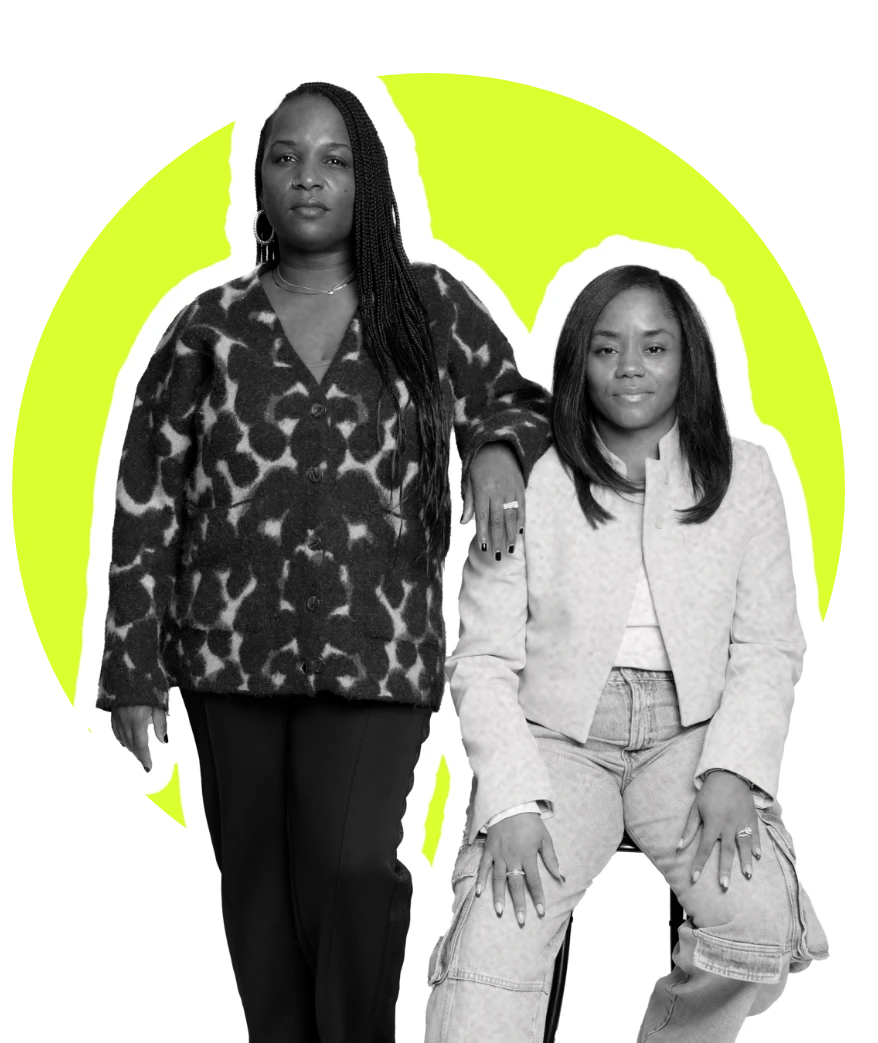
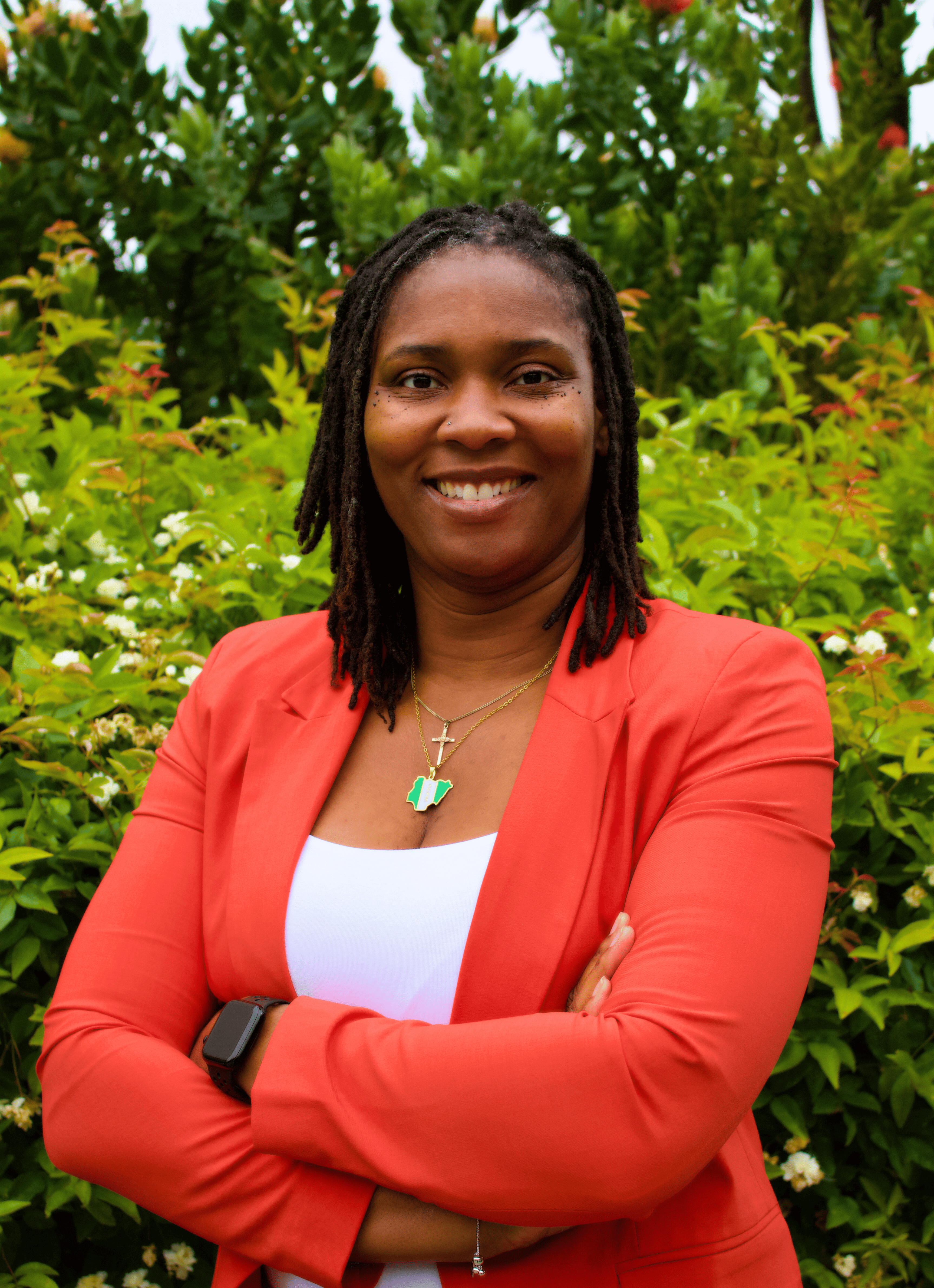
Dr. Eghosa Obaizamomwan-Hamilton is a Black mother scholar who prioritizes scholarship in service of her community. A veteran educator with 16 years of K-12 experience, her research and teaching focus on Black Educational Studies, Black Critical Race Theory, Black Feminist Thought, intersectionality, and the sociology of race and education. She is the co-founder of the nonprofit organization Making Us Matter and a co-founding editor of The Black Educology Mixtape “Journal.” Her scholarship investigates the complex intersections of race, identity, and gender, with work appearing in peer-reviewed journals such as Harvard Educational Review, Race Ethnicity and Education, and Educational Studies.
Author: Dr. Eghosa Obaizamomwan-Hamilton
Student Work
Lesson Plan
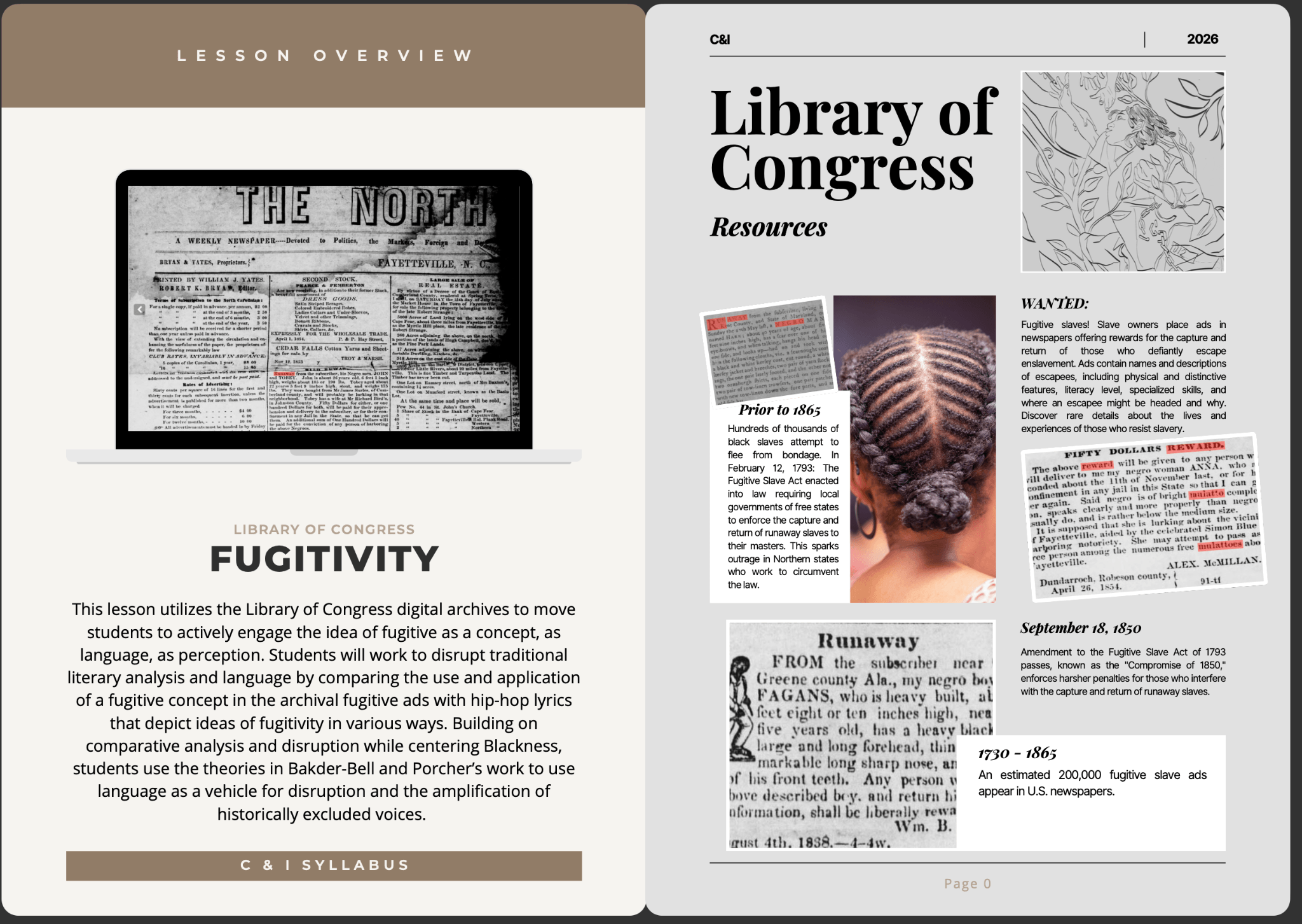
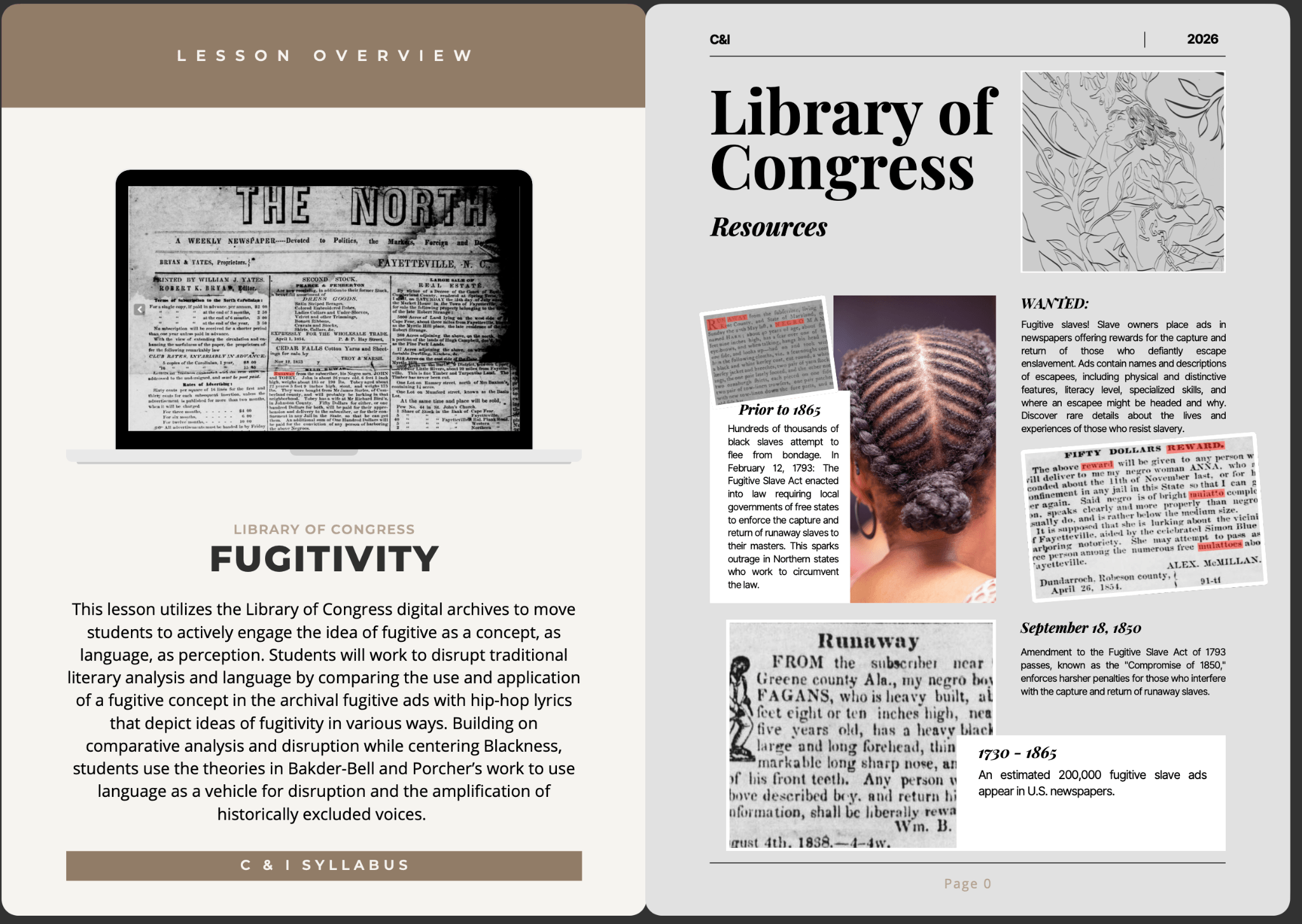
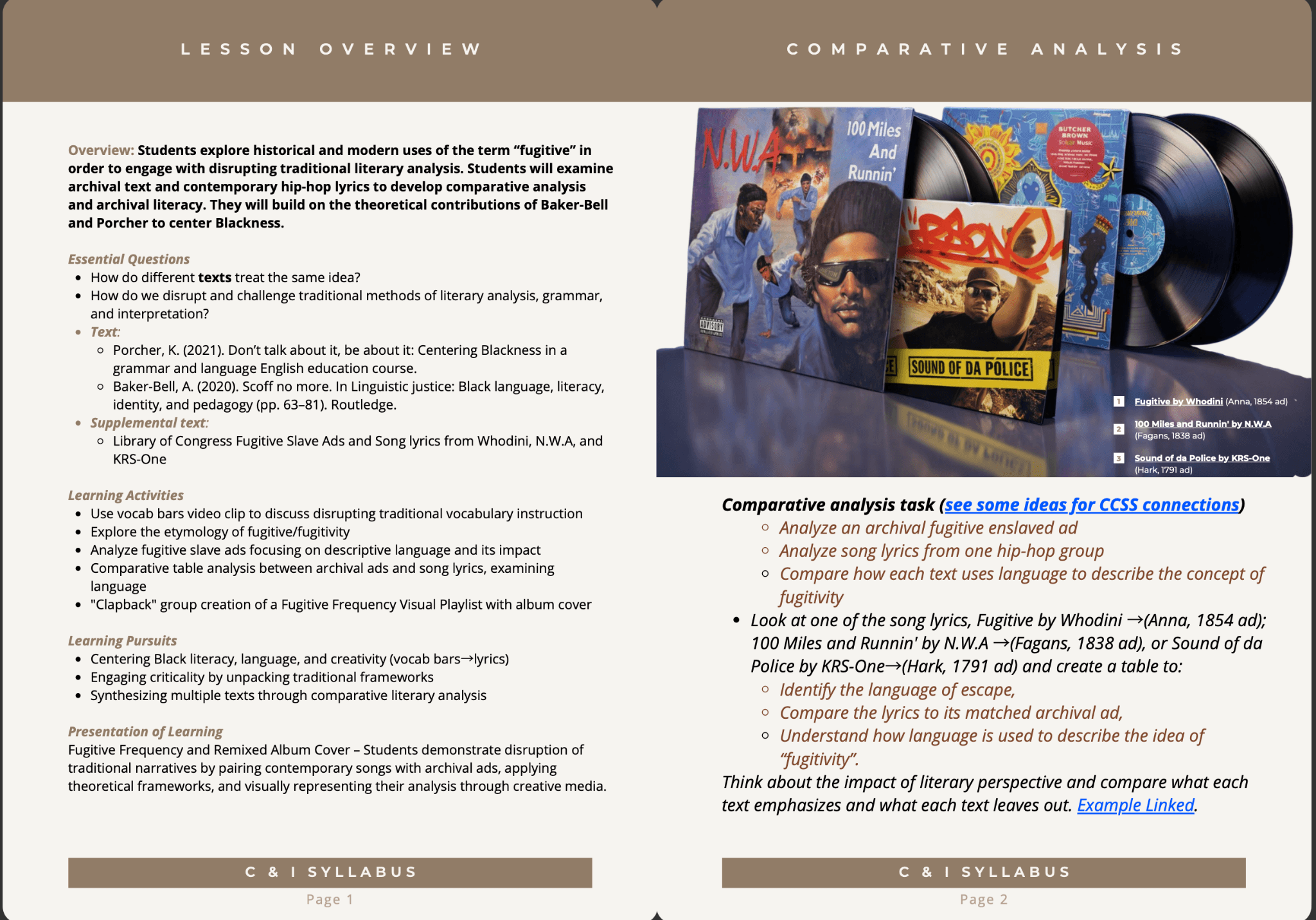
This lesson utilizes the Library of Congress digital archives to move students to actively engage the idea of fugitive as a concept, as language, as perception. Students will work to disrupt traditional literary analysis and language by comparing the use and application of a fugitive concept in the archival fugitive ads with hip-hop lyrics that depict ideas of fugitivity in various ways. Building on comparative analysis and disruption while centering Blackness, students use the theories in Baker-Bell and Porcher’s work to use language as a vehicle for disruption and the amplification of historically excluded voices.
Library of Congress Resources:
Instruction for Task(s):
Objective
&
Rationale
The purpose of this lesson is to explore the historical use of the term fugitive and modern/disruptive uses. The goal is to teach candidates the power of disrupting traditional literary analysis.
Academically, students will benefit from this unit because it will support archival literacy and comparative analysis skills. By incorporating lyrics, it also challenges traditional text as the only source for critical analysis. Students will also apply theoretical framing from the work of Baker-Bell and Porcher.
Personally, socially, or emotionally, students will benefit from this unit because it centers Blackness through creativity by way of music lyrics, disruption of historical perceptions of Blackness, and encourages uplifting historically excluded voices.
Essential Questions
The question(s) that will guide us throughout this unit are:
How do different texts treat the same idea?
How do we disrupt and challenge traditional methods of literary analysis, grammar, and interpretation?
Texts
Primary Texts
Porcher, K. (2021). Don’t talk about it, be about it: Centering Blackness in a grammar and language English education course.
Baker-Bell, A. (2020). Scoff no more. In Linguistic justice: Black language, literacy, identity, and pedagogy (pp. 63–81). Routledge.
Supplementary Texts
Fugitive Ads
Ad 2
Ad 3
Song lyrics from Whodini, NWA, and KRS-One
Lesson
Community building led by a student
In line with the readings, students will think about ways to disrupt traditional methods and think about how they might use something like “Vocab Bars” to engage students in content-specific or text-specific vocabulary. What traditions might this disrupt? How might it be supportive of student understanding of vocabulary or important terms?
Clapback groups share out about the two readings
Together we will look at the definition of Fugitive and the etymology. I will also show students the definition of fugitivity from Gross-Wyrtzen and Moulton. Students will be asked what it might mean to create fugitive classroom spaces and how that might differ from the original definition vs. the (2023). Students should share connects to authors. Students are encouraged to pull in their understandings of the readings to this conversation.
As a class we will look at the three fugitive ads from the Library of Congress. Our focus will specifically be about the language used to describe each person. How is the language used impacting the way we might read each person? How is the description the same or different from the definitions we discussed? 💡→How could TCs have their HS students engage with this archival text?
Students reread the ads and underline words or language that describe “capture”. They answer: What language would you like to disrupt? Why?
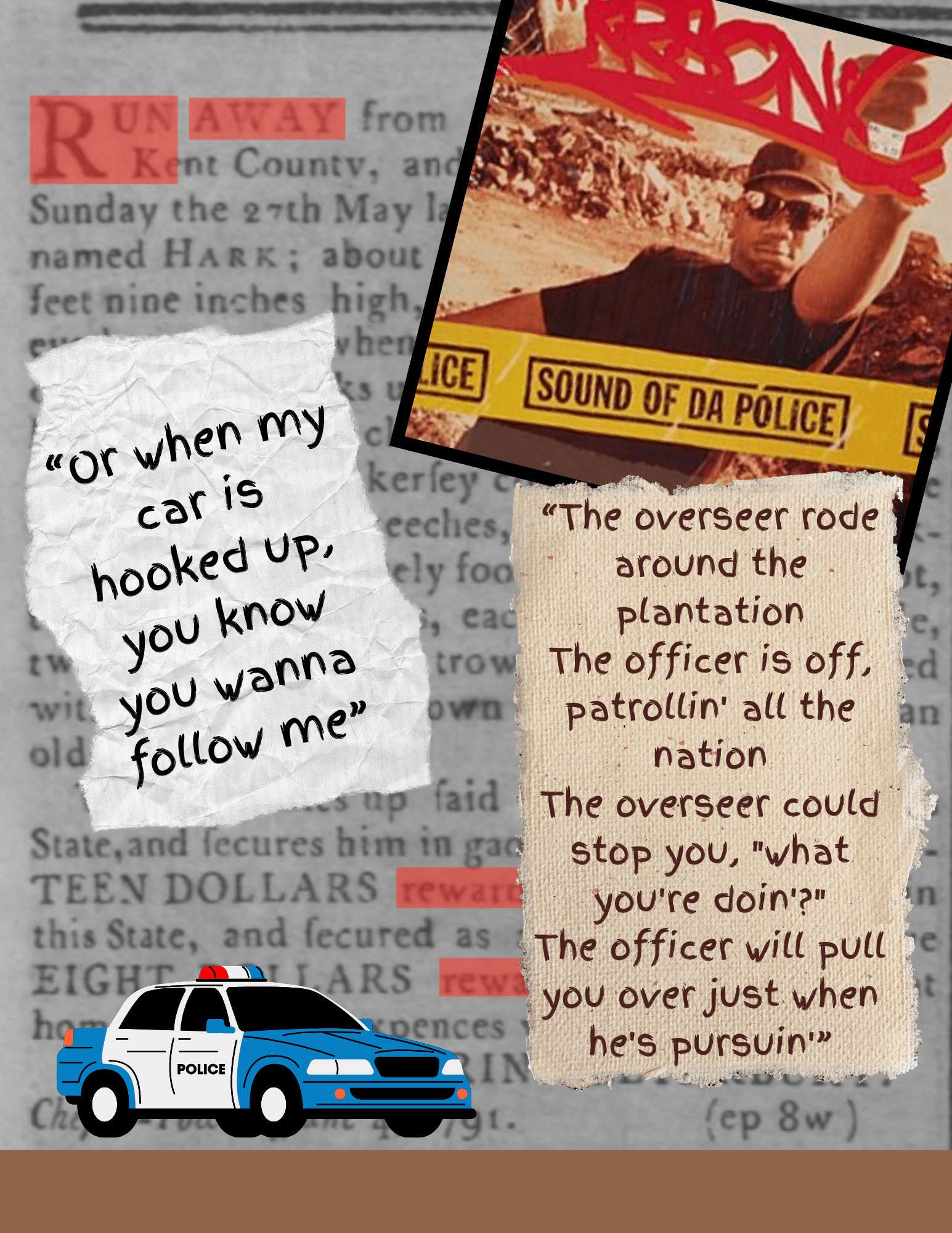
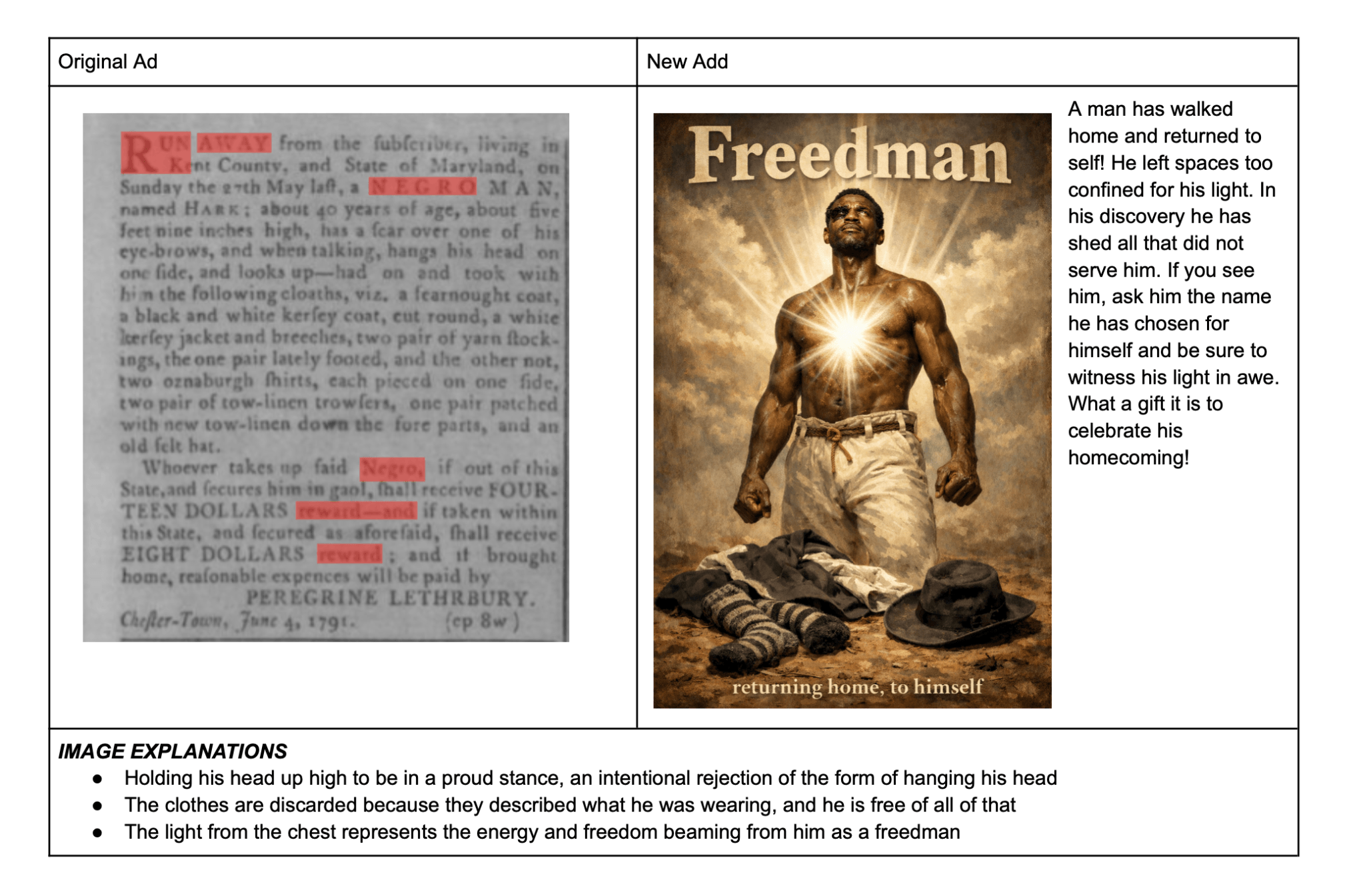
Look at one of three song lyrics (Fugitive by Whodini; 100 Miles and Runnin’ by N.W.A, and Sound of da Police by KRS-One) and create a table identifying the language of escape, compare the lyrics to the archival ad, and understand how language is used to describe the idea of “fugitivity”. Think about the impact of literary perspective and compare what each text emphasizes and what each text leaves out. Check out this example.
Based on Porcher (2021), how does “centering Blackness” change the way we “read” the person in the archival ad versus the person described in the song?
Students will move into their Clapback groups. Together, they will pick 3-5 songs that analyze and disrupt the language found in the Library of Congress Fugitive Slave Ads. Students will also create an album cover via a poster or online.
Directions
Learning Pursuits
Centering Black creativity (vocab bars, AAVE, lyrics)
Engaging in criticality by going beyond reading the ads and unpacking the structures that frame them that way and ways to disrupt.
Synthesize multiple “texts” and do comparative literary analysis
Presentation of Learning
Summative Assessments
I will assess students’ progress toward mastery of learning targets through the use of:
The Fugitive frequency and remixed album cover. Both allow for the concept of disruption to the traditional, historical, or canon to become tangible applications.